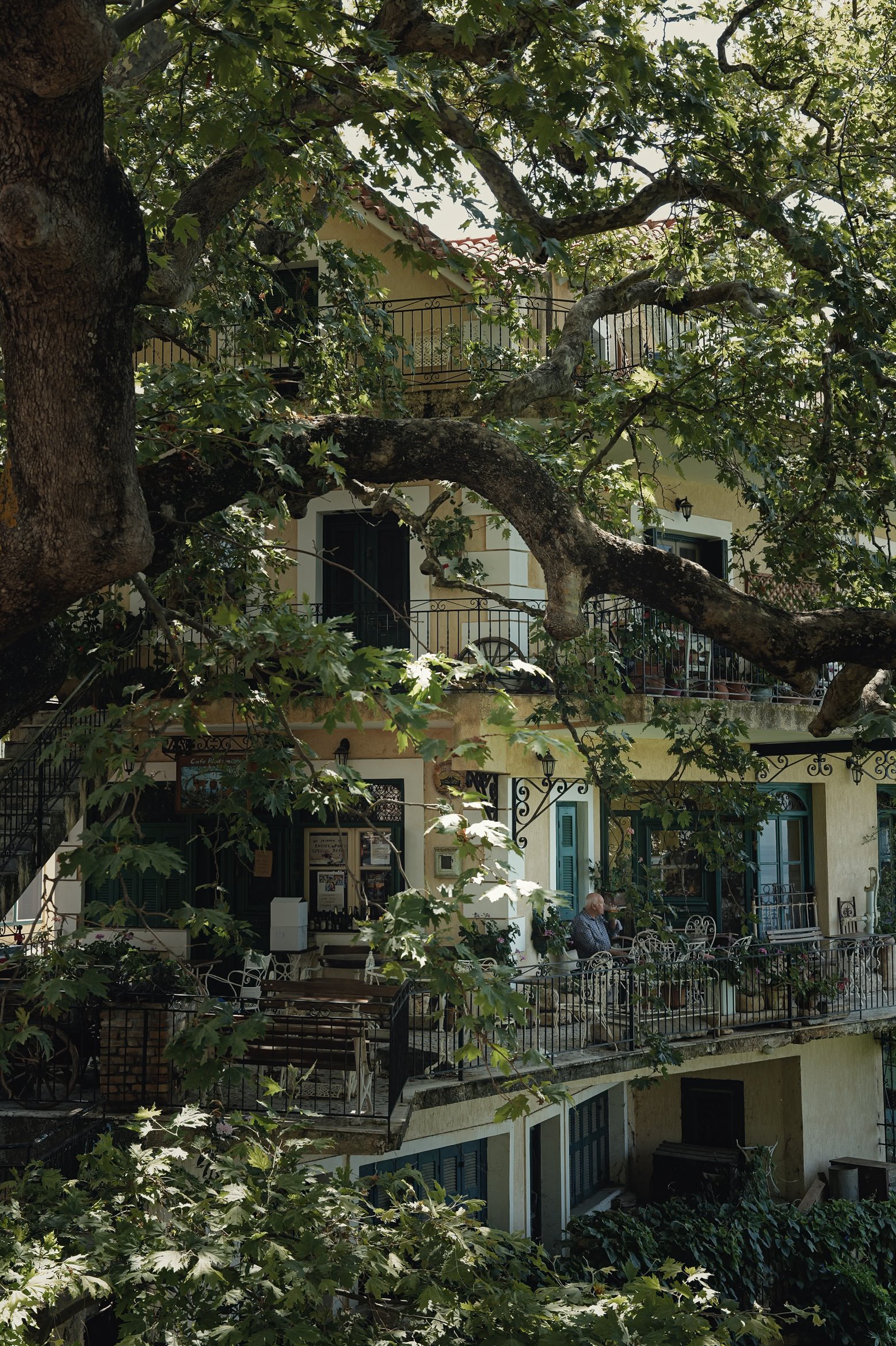
Beneath the Plane Tree
I came to Kefalonia to photograph landscapes. I came home with faces.
This is the story of how that happened – and of how it changed the way I want to photograph.
An island that takes its time
Some islands reveal themselves at once. You land, visit the famous beaches, eat at the tavernas everyone recommends, and leave believing you understand the place.
Kefalonia is not one of them.
It does not demand attention or try to stage its beauty. It unfolds slowly – bend by bend, conversation by conversation, day by day. You don’t discover it. You grow into it.
The first drive across the island makes this clear. Between Argostoli and the far north, the landscape keeps changing. A long bend suddenly opens onto the deep blue of the Ionian Sea; minutes later the coast disappears behind cypresses and silver olive groves. Vineyards give way to pine forest, small villages appear and vanish, and the road climbs until the dark firs of Mount Ainos stand in sharp contrast to the pale coast below. From the summit, the view reaches across to Ithaca, Zakynthos and Lefkada. Only up there do you grasp the scale of the island: larger, wilder and more varied than any map suggests.
In Fiskardo, which the earthquake of 1953 left almost untouched, ochre Venetian façades are mirrored in the harbour and bougainvillea climbs over old balconies. Sailing yachts lie beside small fishing boats, as if the two worlds had never been at odds. Nobody seems to be in a hurry. Some places impress you. Others calm you. Fiskardo belongs to the second kind.
Further along the coast, Assos sits on a narrow spit of land beneath a Venetian fortress. From the top, the village looks small, almost fragile, cradled between two bays. It is one of those views that cannot be photographed – not because the camera fails, but because it cannot convey the size of the space. A photograph is always a fragment. It keeps the moment, never the feeling that came with it.
And then Myrtos. A beach photographed so often that you think you know it before you arrive – until you stand at the viewpoint yourself. White pebbles trace an almost perfect arc between steep limestone cliffs and a sea that changes colour with the wind, from turquoise to a milky ultramarine. As the waves pull back, they drag the pebbles with them, and that deep, rolling sound often stays with you longer than the view. Towards evening the cliffs turn ochre and the blue slowly darkens. No dramatic sunset. Just the day fading.
Nothing on this island feels staged. It has nothing to prove.
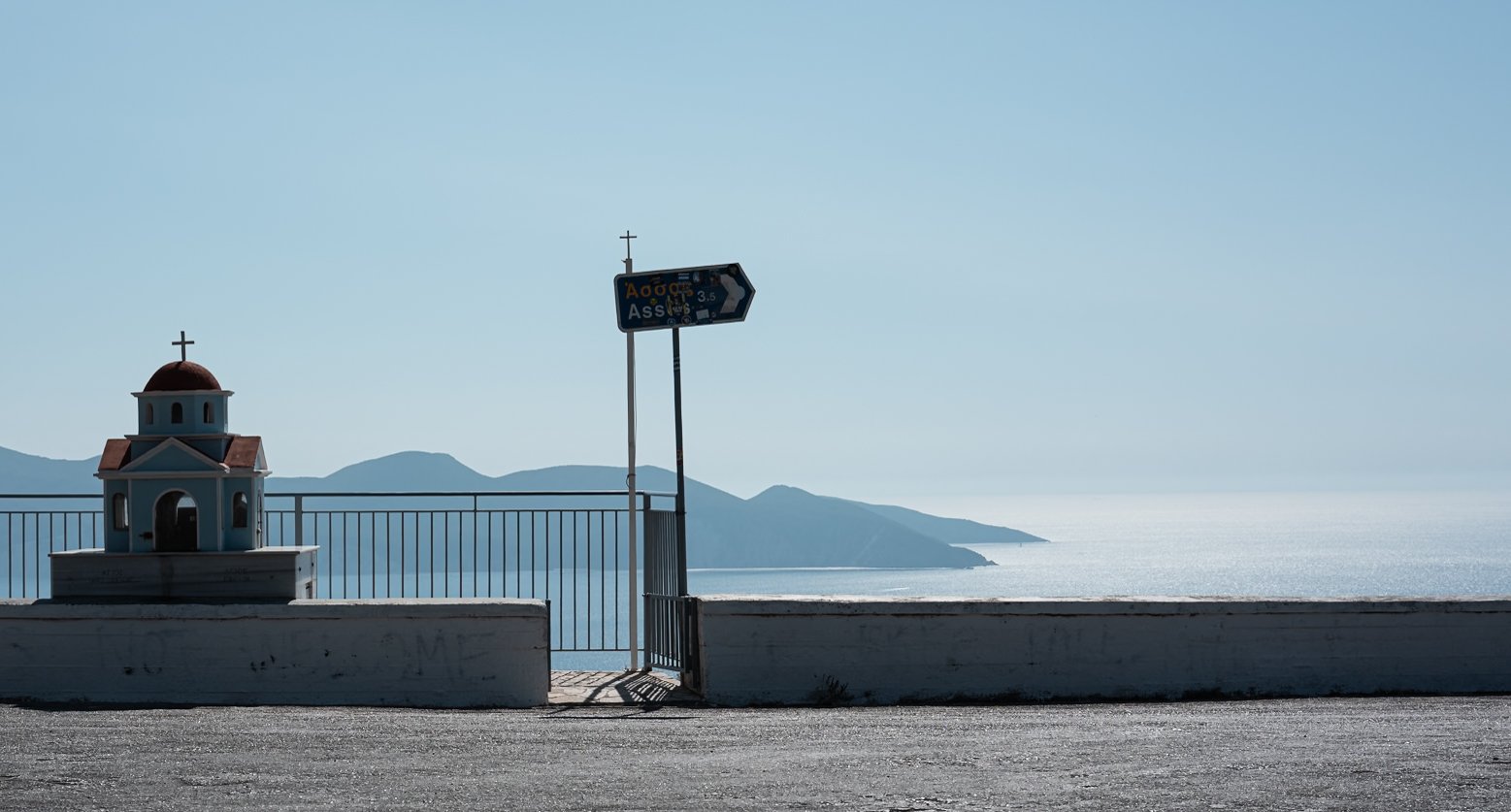
This is a Greek Orthodox roadside shrine, shaped like a miniature church, called a kandylaki or eikonostasi. Such shrines often commemorate someone killed in a road accident, or give thanks for surviving one. The particular dedication of this shrine isn’t visible.
The location is the main-road turn-off to Assos, on Kefalonia’s northwest coast. The sign reads “Άσσος 3.5”, pointing right towards the winding road down to the village.
A different question
As a photographer, I used to begin every journey with the same question: where is the best light? I studied sunrises, searched for viewpoints, worked out when a place would glow its deepest blue and at what time of day the weather would put on its finest show.
Over the years, another question took its place. Who actually lives here? Not as a tourist, not for a week, but every single day. Who opens the café first in the morning? Who knows every vine by name? Who has sat under the same tree for decades, watching the village? Those questions led me to places marked on no map – and that is where the memories that stayed with me were made.
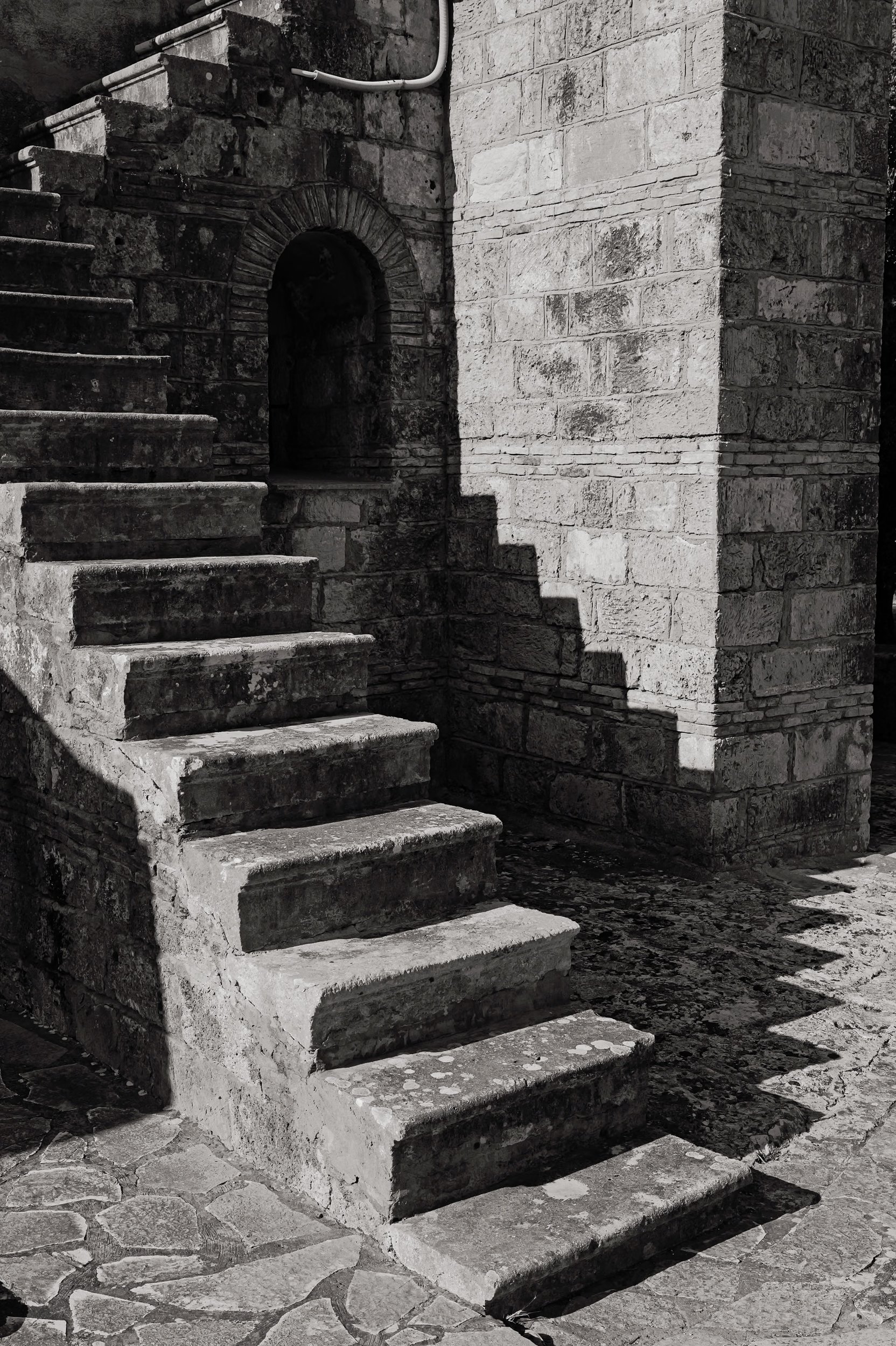
Stone and shadow: the staircase at the Monastery of Agios Andreas Milapidias, Peratata, Kefalonia, drawn twice by the afternoon sun.
The longer I spent on Kefalonia, the less often I reached for the camera straight away. Once that would have worried me. Today I see it as a gift. Sometimes the most important moment is the one you don’t photograph: a stranger’s first smile, the hesitation before a conversation begins, the silence between two people who have only just met. There, a camera would have been a barrier. Curiosity opened doors.
Seeing happens in an instant. Understanding takes time. A beach reveals itself in minutes; a person sometimes only after hours, or days. You can photograph a landscape. Trust has to grow. And so, at some point, photography changes too. It becomes slower. More patient. More personal. You no longer take a picture because something looks spectacular, but because a relationship has formed.
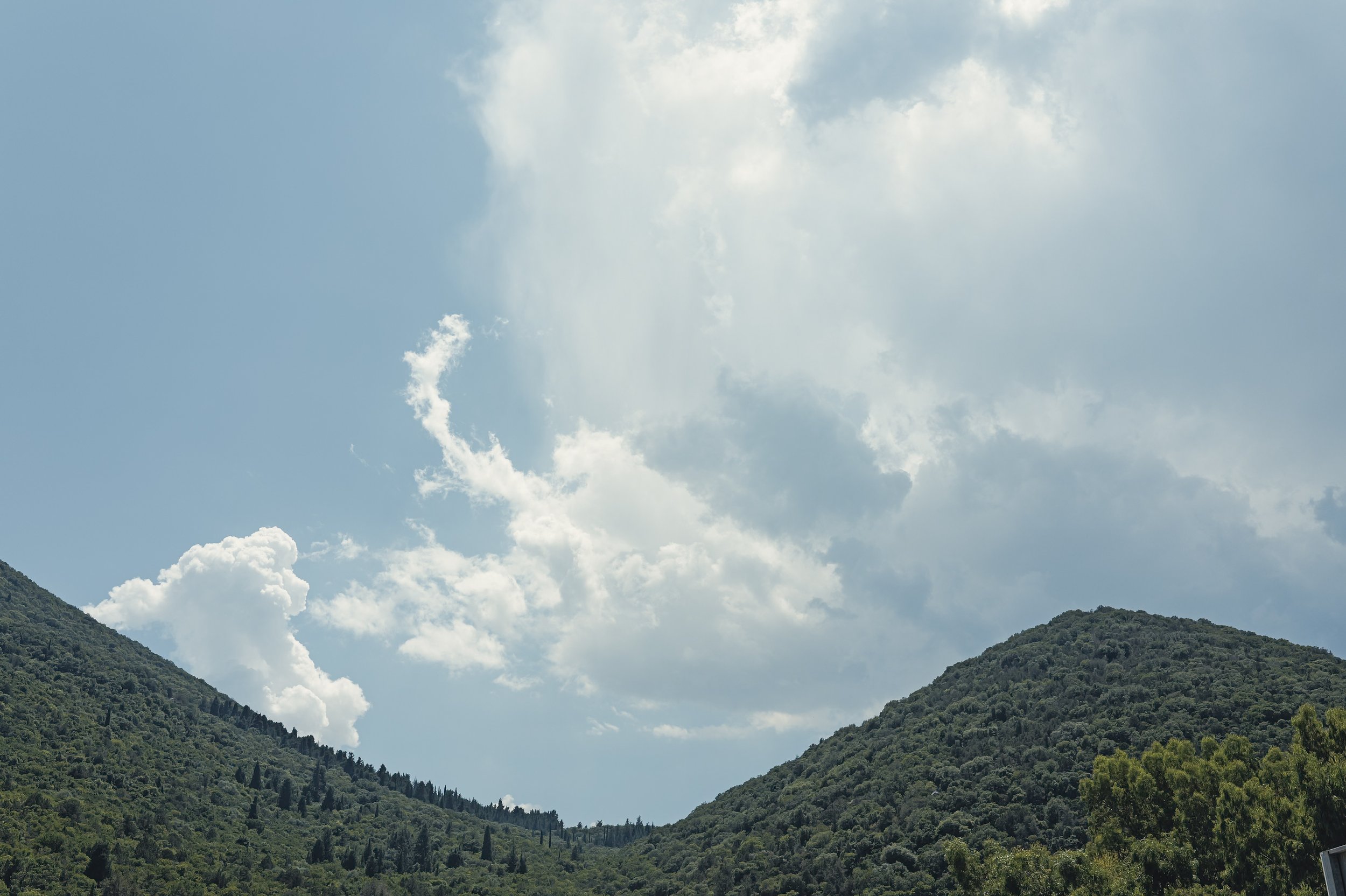
Kefalonia is greener than other Greek islands.
Anna’s kitchen
One day we set out in a small motorboat from Agia Kyriaki near Zola to see the west coast from the sea. The white limestone cliffs rise almost vertically from the water. Coves appear and disappear. The water shifts from pale turquoise to deep blue and back again. Even Myrtos looks different from out there: the cliffs seem higher, the bay opens slowly, almost theatrically. Somewhere along the way, a silence settles that nobody feels the need to break.
As the day draws to a close, the boat returns to Zola. The sun hangs low over the sea. In the small Taverna Stou Tsagari, Anna is making her moussaka to the same recipe she has used for many years.
It is not a restaurant waiting for awards. It lives on something more valuable: people who come back. There may be no finer compliment for a place.
Beneath the plane tree
Sometimes you find a place not because you were looking for it, but because the weather sends you there.
On a very hot afternoon we meant to go to the beach at Lourdata. The heat had other plans. So we turned into a small bar whose name barely caught the eye: Café Platanos.
From the outside it looked unremarkable. A few tables beneath a huge, ancient plane tree, and beyond them a green slope running down to the Ionian Sea. Inside, time seemed to move more slowly. Old scales stood on shelves, on windowsills and in corners, collected over decades. Beside them, things that would long since have been thrown away anywhere else. Nothing looked decorated. Everything seemed to have found its place.
Behind the counter stood Thornton.
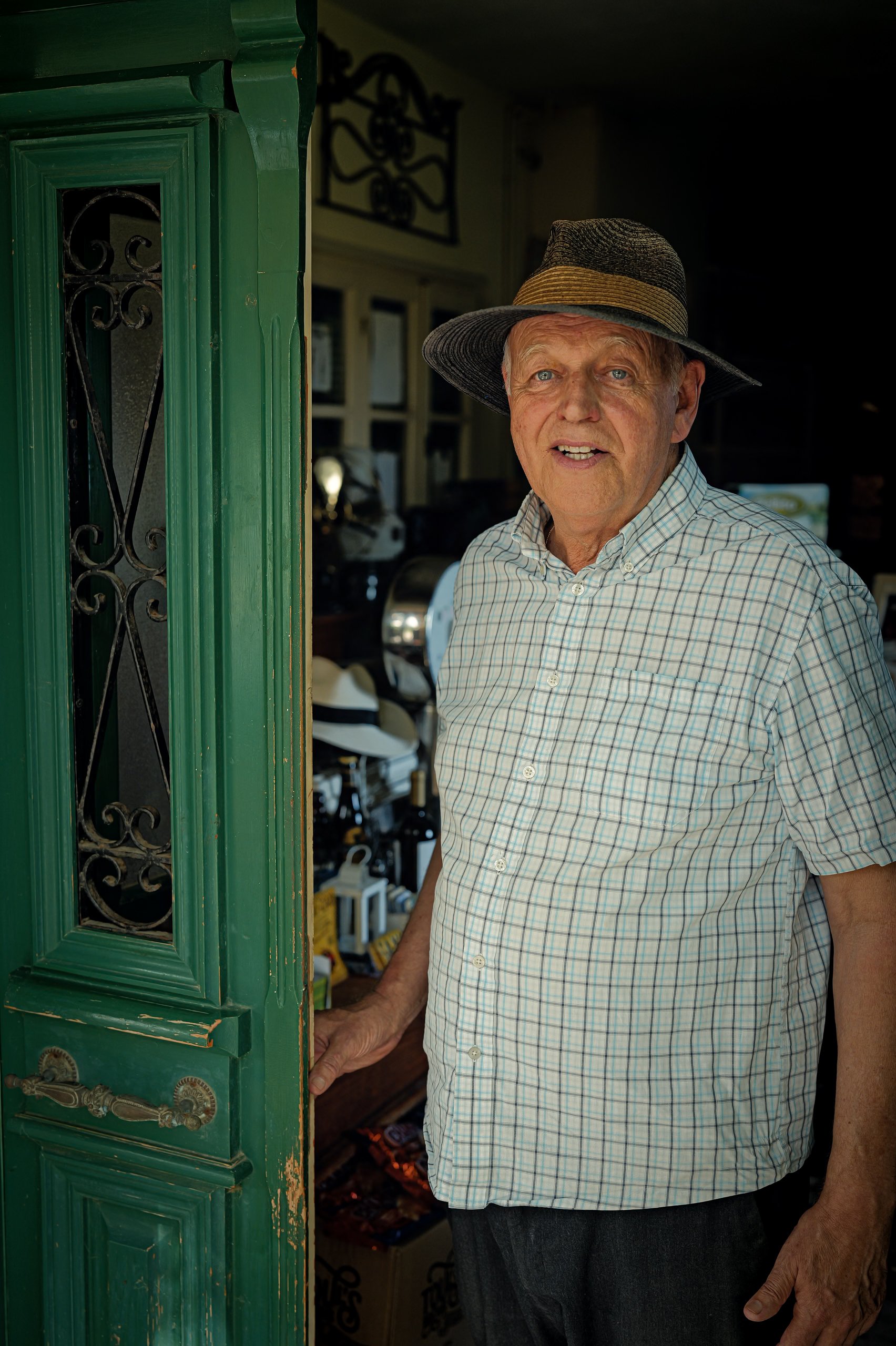
Mr. Thornton from Wales
He is from Wales. He could simply have sold drinks. Instead, he started conversations. He didn’t recommend international brands, but two Greek beers from small breweries, and told us where they came from, who brewed them and why they tasted so different.
We could have moved on long before.
We stayed.
One visit became several – not because of the beer (I hardly drink beer), but because of Thornton.
While I drank his mandarin juice from Lixouri, he told me about his life. At twenty-five he had left Wales for Athens, where he met his future wife. Today he lives with her and their son George in her family’s house in Lourdata. He talked about Newport, his home town, which he often misses – not just the busy life, but the people.
I found that remarkable. I had come to Kefalonia with my family to escape the fast pace of Zurich for a while. Thornton had lived for many years on an island that many see as the very picture of calm – and sometimes missed exactly the opposite. He stayed anyway. Every place gives something, and takes something.
He was just as curious about my life. At some point he mentioned that his daughter was expecting her first child in a few weeks. I smiled to myself. My daughter was expecting her first child too – just a few weeks later.
So there we sat, two older men, one from Wales and one from Switzerland, strangers only days before, on a Greek island, talking about what it would be like to become grandfathers.
Soon after came the next of those small coincidences that travel sometimes holds in store. The mandarin juice I ordered every morning came from Lixouri – of all places, where the family of my best friend, whom I have known since childhood, has its roots. Nobody could have planned it, and yet it brought an immediate sense of familiarity.
With every visit I photographed a little more. First the bar. Then the old scales. The light beneath the plane tree. An old BMW motorcycle and a red car that seemed to have stood under the tree for years. A rickety telephone box from a time long before mobile phones. And finally, Thornton.
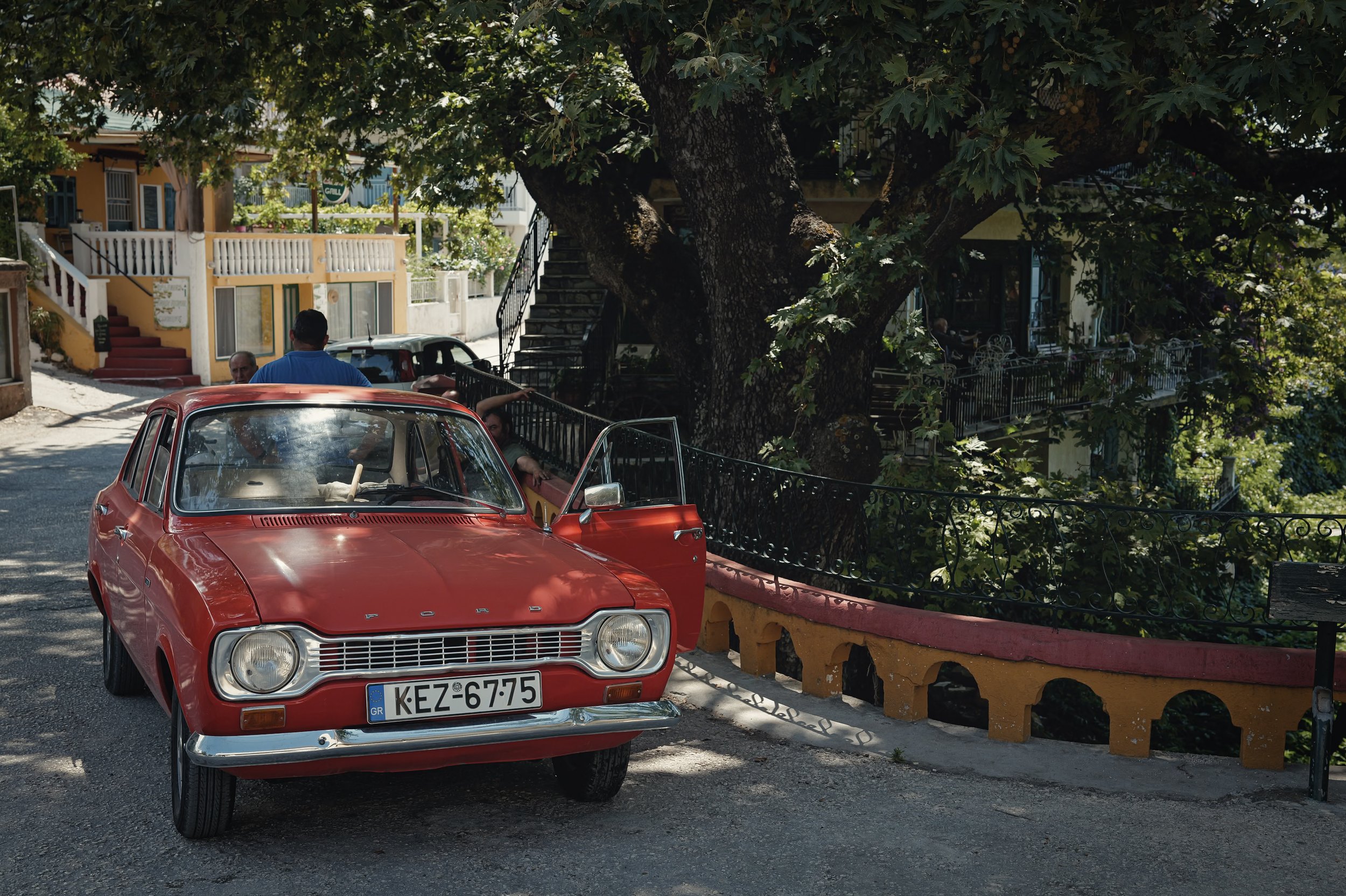
The pictures were not made because I set out to photograph. They happened between our conversations, almost in passing. At some point Thornton stopped noticing the camera. He had nothing to perform. He was simply himself. That may be how the best photographs come about: not taken, but made possible by trust.
Many visitors later write about the view, the unusual interior or the remarkable choice of beer. They are all right. But I don’t think that is the real reason the place stays with them. Platanos is not a bar. Platanos is Thornton’s world.
Over many years he has created a place where strangers stop being strangers for a while. Nobody is pushed to talk, and yet almost everyone ends up telling their story. It might be the old plane tree. It might be the view of the sea. Most likely it is Thornton, who never tries to seem interesting – and is all the more interesting for it.
When we said goodbye, I did not feel I had met a barman. I had met an extraordinary person.
The next day I wanted to go back once more. It was Saturday, and the bar was closed. One last photograph beneath the plane tree: a closed door. And I thought about how I want to photograph from now on.
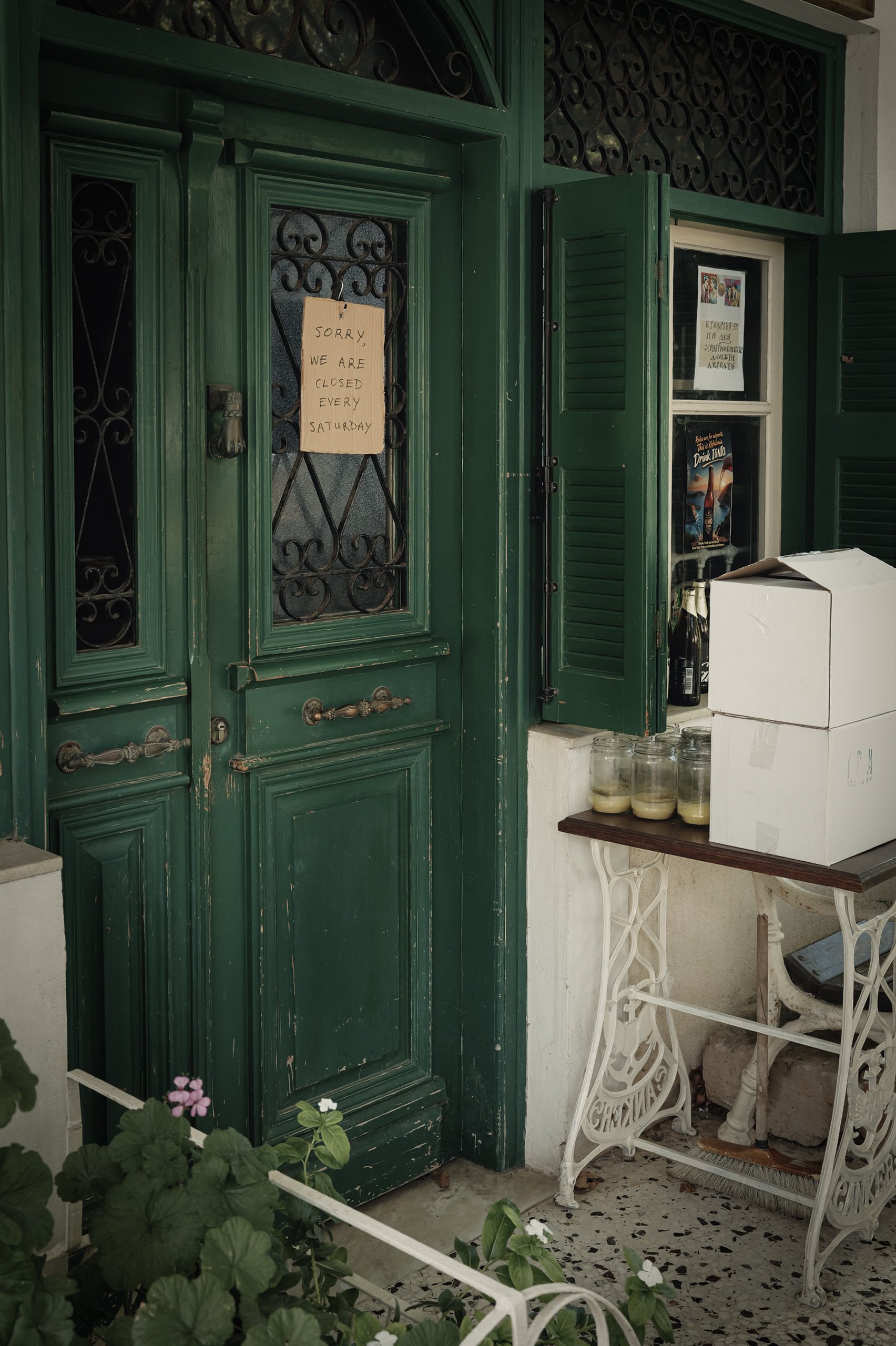
It was Saturday, and the bar was closed.
Coming home
On the way back to Zurich, I saw the deep blue of the Ionian Sea once more, the white limestone cliffs, the cypresses on the hillsides. I had come to Kefalonia to photograph landscapes and to enjoy a relaxed week away. I took home something else: the understanding that the better photographs often grow out of encounters – in the moment when people stop presenting themselves and, trusting you, simply begin to be who they are.
The photographs here are not a complete record of Kefalonia. They are fragments – attempts to hold on to light, landscape and mood. The text tells what happened between the pictures. Because much of what makes a journey matter cannot be photographed.
It lives on in memories. In conversations. And in the people we meet.